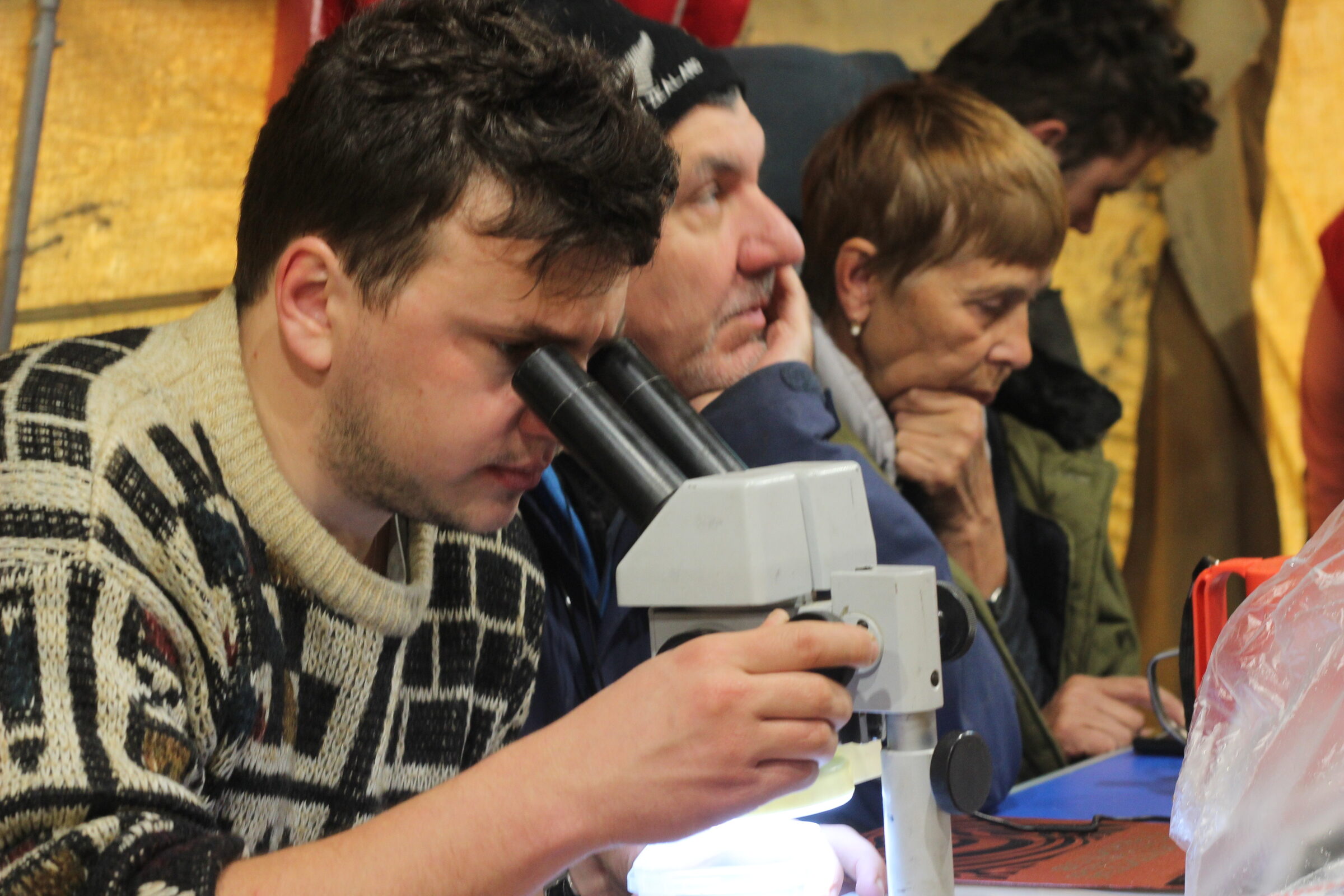
Anton Kutyrev working at a microscope.

Microscopy and textures

Petrography

When size does not matter

23AK127

Chromitite stringers at the footwall of the Upper Chromitite, Akanvaara layered intrusion, Lapland, Finland. Thin section is oriented, and the left side corresponds to higher stratigraphy. The section comprises Cr-spinel (opaque), elongated clinopyroxene crystals almost entirely converted into actinolite (colourless to green), and biotite (brown). Biotite appears exactly at the same level as the largest Cr-spinel segregation that forms the matrix of chromitite and the overlying silicate rock. This feature is pretty unique for Akanvaara and nearby coeval Koitelainen intrusions. Large thin section, ≈10×2.2 cm.

Hornblende wehrlite

A rare case of hornblende being a dominant mineral in a layered intrusion. This sample belongs to the lower ultramafic part of the Rhiw layered intrusion in Wales. Olivine phenocrysts occur as inclusions in poikilitic crystals of clinopyroxene (colourless) and hornblende (brown). The latter two minerals transition into each other seamlessly, a characteristic feature of Rhiw rocks from peridotites to gabbro. Hornblende has strong pleochroism, appearing from dark brown to pale orange. Opaque inclusions in olivine are Cr-spinel, whereas large opaque minerals in the matrix are magnetite. The host intrusion is located in an arc-related setting and is extremely depleted in chalcophile elements, suggesting sulphide accumulation below. Sample RW23-20.